
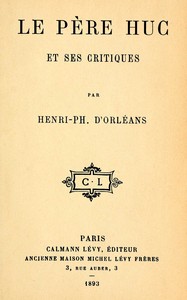
Le père Huc et ses critiques by Prince Henri d' Orléans
Picture this: in the 1840s, a French Catholic missionary named Father Évariste Huc returns from an epic, years-long journey through Mongolia and Tibet. He writes a book about it, 'Travels in Tartary, Thibet, and China,' which becomes a huge hit in Europe. People are captivated by his stories of lamaseries, the Dalai Lama, and forbidden cities. But then, the whispers start. Other travelers and scholars begin to question his account. Did he really go to Lhasa? Was he exaggerating? The controversy simmers for decades.
The Story
This book isn't Father Huc's story. It's the story of what happened after. Prince Henri d'Orléans, a fellow explorer and a friend to Huc, steps in as his defender. The prince acts like a lawyer presenting a case. He goes point-by-point through the major criticisms leveled against Huc. He pulls out old diaries, compares Huc's descriptions with those of later, verified explorers, and highlights the inconsistencies in the accusers' own arguments. He argues that much of the doubt came from professional jealousy, political bias against missionaries, and simple ignorance of the region. The book is a detailed, passionate reconstruction aimed at clearing a man's name long after the journey was over.
Why You Should Read It
What grabbed me wasn't just the travelogue stuff, but the human drama. It's a powerful look at how history gets written and challenged. Huc wasn't just defending facts; he was defending his life's work and his integrity. Prince Henri's writing shows a fierce loyalty. You feel his frustration at what he sees as petty and unfair attacks. It makes you think about how we judge explorers' tales today. How much trust do we put in a single narrator? The book is also a snapshot of 19th-century European intellectual culture—full of big egos, rivalry between scientific and religious circles, and a hunger for 'authentic' stories from the East.
Final Verdict
This is a niche but totally engaging read. It's perfect for history buffs who enjoy deep dives into specific controversies, or for anyone interested in the history of exploration and how truth gets debated. It's also great if you like narratives about underdogs (or in this case, posthumous reputations) getting a fair defense. You don't need to have read Huc's original book to follow along, but it helps to have a little patience for 19th-century prose and detailed geographical arguments. Think of it as a historical detective story where the prize is the truth.
This work has been identified as being free of known copyright restrictions. It serves as a testament to our shared literary heritage.
Kimberly Clark
9 months agoAmazing book.
James Thompson
1 year agoVery helpful, thanks.
Thomas Lee
1 year agoI had low expectations initially, however the storytelling feels authentic and emotionally grounded. Absolutely essential reading.
Sandra Sanchez
1 year agoAfter finishing this book, it provides a comprehensive overview perfect for everyone. This story will stay with me.






Carol Moore
1 year agoNot bad at all.